 English
  Русский
  中文
中文  Español
  Deutsch
  Français
 NICs with optical ports: an overview
The other end of every server link is a network interface card (NIC), and it plays the same game as the switch — cages, SerDes lanes, a management bus to the module, a policy about which modules it accepts — with two differences: the policy lives in a driver, not a network OS, and the bottleneck is often the PCIe bus, not the port. This section covers NICs with SFP/QSFP-class cages: the families and vendors, how ports relate to PCIe, transceiver compatibility and its driver-level overrides, the tools that read a module from the server side, and the programmable adapters (SmartNICs, DPUs) that blur the line between card and switch.
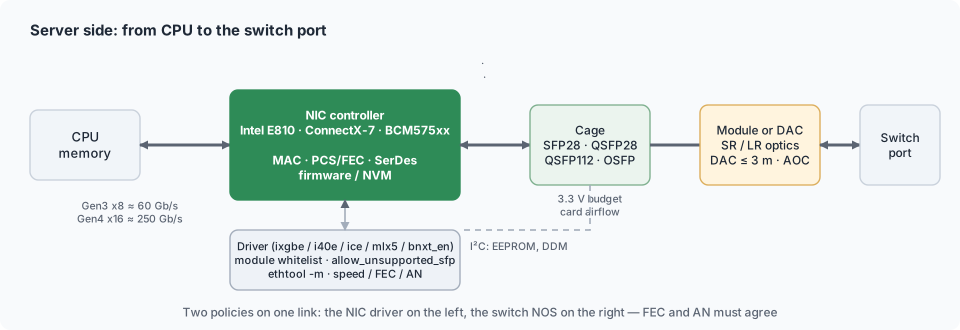
What a NIC is, in optics terms
| Element | On a switch | On a NIC |
|---|---|---|
| Cages | 24–64 per box | 1–4 per card (1–2 typical) |
| SerDes | forwarding ASIC | NIC controller ASIC (Intel E810, Broadcom BCM57508, Nvidia ConnectX-7…) |
| Module management | NOS over I²C mux and CPLD | driver/firmware over the controller's I²C |
| Policy | NOS whitelist (How each NOS validates a module) | driver/firmware whitelist (Optics compatibility on NICs) |
| Speed/FEC config | CLI | ethtool, vendor tools, BIOS/UEFI, OS device manager (Tools) |
| Backhaul | fabric ASIC | PCIe lanes to the CPU (Ports & PCIe) |
| Power | 3.3 V per cage from the chassis | PCIe slot (25–75 W) plus auxiliary connector on high-end cards |
Form factors of the card
| Card type | Where | Ports |
|---|---|---|
| PCIe add-in card (half-height half-length, full-height) | any server slot | 1–2 × SFP28/QSFP28, 1–2 × QSFP56/QSFP112/QSFP-DD/OSFP |
| OCP NIC 3.0 (SFF / LFF mezzanine) | OCP slot at the rear of the server | same cages, front-accessible, hot-swap on some chassis |
| LOM / embedded | on the motherboard | usually RJ45; SFP+ on some |
| Mezzanine / blade | blade servers | connects to blade chassis switch, no cages |
| SmartNIC / DPU | PCIe or OCP | 2 × 100/200/400G, own Arm cores (SmartNICs & DPUs) |
Families and vendors
| Vendor | Families (optical-port models) | Speeds | Cages | Driver (Linux) |
|---|---|---|---|---|
| Intel | X520 / X710 / XXV710 / E810 / E830 | 10G / 10G / 25G / 25–100G / 200G | SFP+, SFP28, QSFP28, QSFP56 | ixgbe, i40e, ice, idpf |
| Nvidia (Mellanox) | ConnectX-4 Lx / -5 / -6 Dx / -6 Lx / -7 / -8 SuperNIC | 25G / 100G / 100–200G / 25–50G / 200–400G / 800G | SFP28, QSFP28, QSFP56, QSFP112, OSFP | mlx5_core |
| Broadcom | NetXtreme-E BCM5741x / 5750x (P225, P425, P2100, P1400GD) | 25G / 100–200G / 400G | SFP28, QSFP56, QSFP-DD | bnxt_en |
| Marvell (QLogic) | FastLinQ 41000 / 45000 | 10–25G / 100G | SFP28, QSFP28 | qede |
| AMD (Solarflare, Pensando) | X2522 / X3522; Pensando DSC | 10–25G; 100–200G | SFP28; QSFP56 | sfc; ionic |
| Chelsio | T6 | 10–100G | SFP28, QSFP28 | cxgb4 |
| Others | Silicom, Napatech (FPGA), Xilinx/AMD Alveo, Netronome | 10–100G | mixed | — |
Speeds per card model are fixed by controller and cages; "25G capable" means 10G and 25G, rarely 1G (Ports & PCIe).
What the NIC needs from a module
- Compliance codes for a speed the controller supports at that cage.
- Identity the driver accepts — Intel families are the strict ones (Optics compatibility on NICs).
- FEC/AN behaviour the driver can match: DAC at 25G+ requires Clause 73 AN on both ends; optics need forced speed and matching FEC (FEC & AN).
- Power class within the card's cage budget — most NICs allow QSFP28 class 4 (3.5 W) and QSFP-DD up to 12–15 W; check for ZR/tunable modules (Power & consumption).
- Cooling: server airflow is front-to-back through the card; modules on rear-facing cards sit in exhaust air (Temperature grades).
Typical roles and their optics
| Role | NIC | Link |
|---|---|---|
| General virtualisation host | 2 × 25G SFP28 | DAC to ToR (Roles & topologies) |
| Storage / NVMe-oF | 2 × 100G QSFP28 | DAC/AOC, RoCE with PFC (Lossless Ethernet) |
| GPU server | 4–8 × 400G OSFP/QSFP112 (one per GPU) | AOC/DR4 to rail leaves (Cabling an AI cluster) |
| HPC | InfiniBand HCA 1–2 × NDR/XDR | DAC/AOC (IB cables) |
| Edge / branch | 2 × 10G SFP+ | LR to a campus core |
| Management / OOB | 1G RJ45 or SFP | — |
Further reading
- NIC ports, speeds and PCIe bandwidth — cages on NICs, dual rate, breakout cables, PCIe generation × lanes vs port totals, OCP 3.0, power and cooling.
- Transceiver compatibility on NICs — driver whitelists by vendor, Intel
allow_unsupported_sfp, Windows/ESXi behaviour, FEC/AN with DAC and optics, what to code. - NIC tools and diagnostics —
ethtool -m, mlxlink, bnxtnvm, Intel tools, Windows and ESXi commands, reading DDM and FEC counters from the server. - SmartNICs and DPUs — BlueField, Pensando, IPU: ports and optics on programmable adapters.
In CodingBox
A module that a NIC rejects is diagnosed the same way as one a switch rejects: read the identity and compliance codes on the bench, compare with the driver's list, code if the policy demands it (Check transceiver, Vendor lock).